CHOCOLATE: FROM MÉXICO TO THE REST OF THE WORLD
- Rafael Paramo
- Jun 19, 2024
- 2 min read


Although the origin of the cacao plant has been a topic of research, with Central America often credited for its development, it was the Olmecs who domesticated the plant and started making products with cacao seeds. In fact, the first known drink made from cacao consisted of ground cacao beans mixed with water, herbs, and, of course, chiles. This drink was called xchocalt.
As with many things that have origins in pre-Hispanic Mexico, the origin of cacao is told through one of the most beautiful legends, in my opinion. It is said that Quetzalcóatl (the god of wisdom and fertility) gave the Toltecs cacao beans so they could be well-nourished and become knowledgeable and wise. Quetzalcóatl had stolen the cacao tree from the paradise of the gods and planted it in Tula, in what is now Tula de Allende in Hidalgo, Mexico. He then asked Tláloc (the god of rain) to send rain so the tree could grow, and Xochiquetzal (the goddess of love and beauty) to give it beautiful flowers. Thus, the plant flourished and bore the fruits that we now know and value.

Over time, the Mayans adopted the cultivation and use of cacao, perfecting its applications. They started with a drink very similar to the one made by the Olmecs, calling it tchocolat. This beverage was reserved exclusively for emperors, nobles, and warriors, as cacao seeds and beans were more valuable than gold at that time and were even used as currency in bartering.
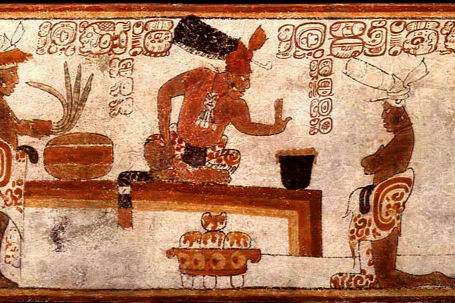
With the arrival of the Spanish to Mexican lands, it is believed that Hernán Cortés, upon seeing the native leaders consuming this beverage, negotiated the purchase of cacao with gold. This marked the beginning of the Spanish enjoyment of the same drink, albeit with the addition of sugar to sweeten it. In one of the letters he sent to Carlos V, Cortés mentioned that just one cup of this beverage was enough to replenish a soldier's strength for an entire day, serving as a natural remedy to ensure survival to some extent.
Around 1528, when Hernán Cortés returned to Spain, he brought with him a shipment of cacao along with the necessary utensils for processing it. Upon arrival in Spain, cacao pods were fermented, sun-dried, roasted, and pressed between hot stones to obtain a paste. This paste was molded into bars and mixed with water, sugar or honey, and spices, marking the beginning of chocolate as we know it today.
Chocolate and its refinement reached France in 1615, followed by Germany and England in 1646 and 1657, respectively. In 1828, Coenraad Van Houten invented cocoa powder, and in 1870, Daniel Peter mixed cocoa with sugar and milk to create the chocolate bars we know today.

Over the years, we've witnessed the emergence of various types of chocolate, including dark, milk, white, and in 2017, pink chocolate. Regardless of your chocolate preference, one thing is certain: it's one of the many products that originated in Mexico for the entire world to enjoy. You're welcome!


Comments